
Fiber Link Down? How a 28.89 USD OPM-VFL Combo Tester Diagnoses Fiber Faults in Minutes
I manage the network for a 12-building hospitality property, and last month a guest wing went completely dark — no connectivity to the PMS, no VoIP phones, no guest WiFi. The core switch showed the fiber uplink was down, but that's all it told me. When a fiber link drops, a switch can tell you it's down — but not why. Is it a break in the cable? A dirty connector? A failed SFP? Without the right tool, you're guessing.
I'd been borrowing an OTDR from a contractor friend whenever something broke, but calling in a favor at 11 PM on a Tuesday isn't sustainable. I needed something affordable that could answer two questions fast: is there light on this fiber, and if not, where did it stop? That's exactly what the D YEDEMC OPM-VFL combo tester is built for — and after six weeks of using it across indoor and outdoor fiber runs, here's what it can and can't do.
The Problem: Fiber Troubleshooting Without Spending Thousands
A real OTDR costs anywhere from 800 to several thousand dollars. For a hotel, restaurant, or small commercial property with a handful of fiber runs, that's hard to justify. But the alternative — calling a contractor every time a link goes down — costs even more in downtime. There's a middle ground: a portable optical power meter with a built-in visual fault locator that covers 90% of real-world fiber faults for under 30 USD.
The most common fiber problems on a commercial property aren't exotic. A patch cable gets kinked behind a rack. A connector collects dust after a nearby ceiling tile replacement. An SFP module dies silently. A field termination wasn't polished correctly and degrades over time. Every one of these can be diagnosed with two tools: something that measures light levels (OPM) and something that shoots visible light through the core to reveal breaks (VFL). The D YEDEMC puts both in one handheld unit, plus an RJ45 tester for copper lines.
The Solution: D YEDEMC OPM-VFL Combo Tester
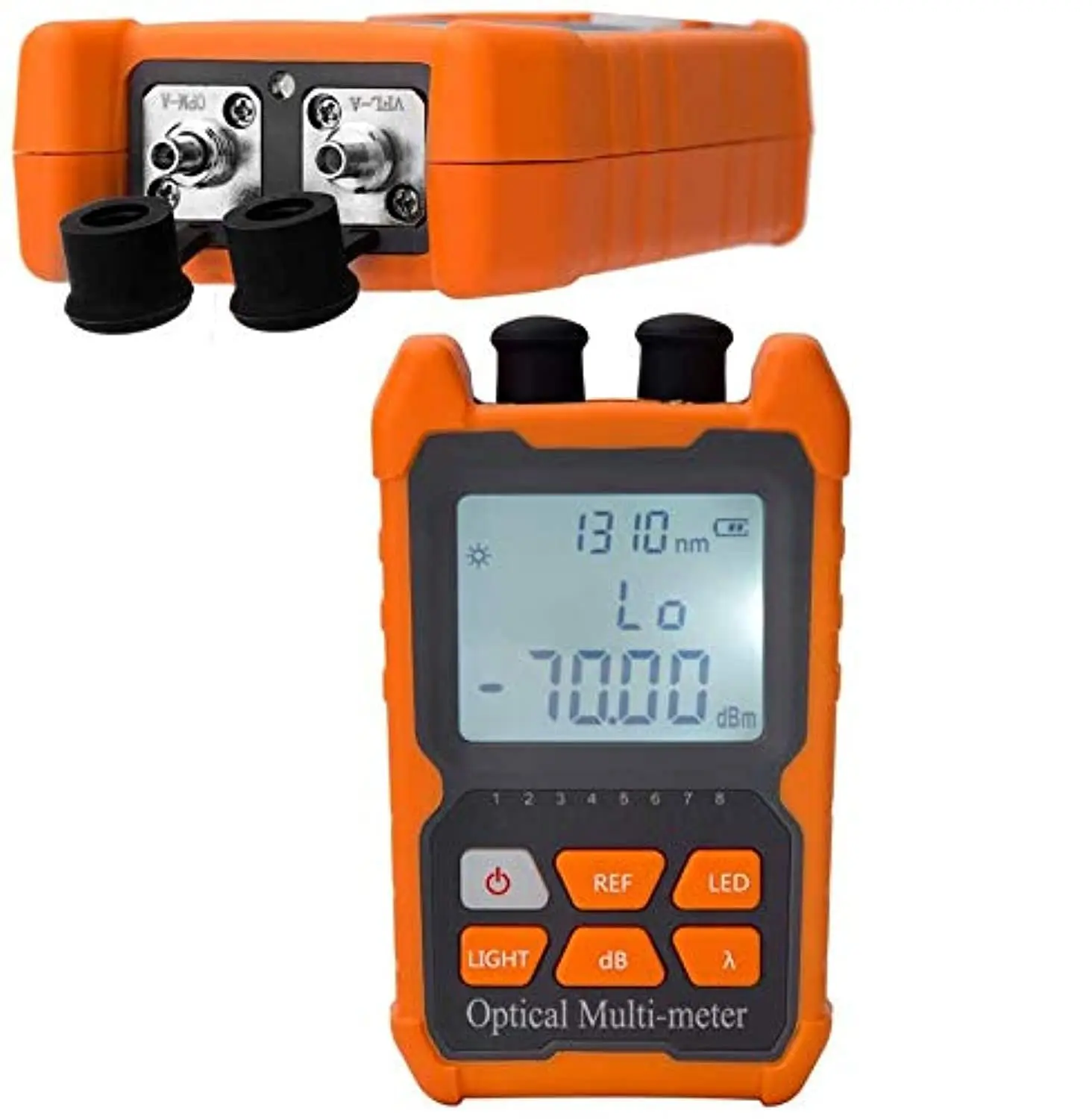
The unit is about the size of a small multimeter — fits in one hand, runs on two AA batteries, and powers on with a single button. The interface is refreshingly simple: one port for the optical power meter (FC/SC/ST universal), one port for the visual fault locator, and an RJ45 jack for copper cable testing. No menus, no calibration screens, no firmware to update. You plug in and read the number.
The OPM measures optical power from -70 dBm to +10 dBm across six calibrated wavelengths (850/1300/1310/1490/1550/1625nm), covering both multimode and single-mode fiber. For reference, a typical SFP module has a receive sensitivity around -24 dBm — if your reading is significantly lower than that, you've got a loss problem somewhere in the link. The VFL outputs a visible red laser at 1mW that can shoot through 8 to 10 kilometers of fiber, making breaks and severe bends immediately visible as a glowing red spot.
The RJ45 tester is a bonus — it checks continuity and wiremap on CAT5/CAT6/CAT7 cables with a removable remote unit. It won't certify cable or measure crosstalk, but for verifying that all eight pins are in the right order after you crimp a new end, it does the job.
What It Gets Right in the Field
The VFL is the star of the show. During a recent outdoor fiber fault between the main building and a pool house, I connected the VFL to the LC patch panel in the server room, walked 300 feet to the pool house, and immediately spotted the glowing red leak where a landscaping crew had nicked the armor with a weed trimmer. That diagnosis took under five minutes — without the VFL, I would've been running back and forth with patch cables or guessing which segment to replace.

The OPM is accurate enough for go/no-go and relative measurements. I compared readings against a calibrated EXFO meter on the same fiber and the D YEDEMC was within 1.5 dB — not lab-grade, but close enough to tell you whether a link is healthy, marginal, or dead. For checking light levels at the end of an FTTH drop or verifying that a new patch cable isn't defective out of the bag, it's perfectly adequate. The VFL's real diagnostic power shows most clearly when you're hunting a break. Insert the faulty fiber into the red light port, and the laser travels until it hits the break — no light comes out the other end. Compare that against a known-good fiber, where the red light exits cleanly, and you've confirmed the fault in seconds.
The key is understanding what it won't do: it won't tell you exactly where a break is (that's OTDR territory), and the absolute power readings can drift by a couple dB depending on battery level and connector cleanliness.
Battery life is excellent. I've been using the same pair of AAs for six weeks of intermittent testing, and the auto-shutoff after 10 minutes of inactivity means you won't find it dead in your tool bag.
What It Doesn't Do
The biggest limitation is connector compatibility. The OPM port uses a 2.5mm universal ferrule that accepts FC, SC, and ST connectors natively — but LC connectors require an adapter (not included). If most of your plant uses LC connectors, budget an extra few dollars for an FC-to-LC adapter or you won't be able to plug anything in.
The VFL is 1mW — enough for indoor and short outdoor runs, but don't expect it to light up a break on a 20-kilometer buried span. For campus-scale networks, you'd want a 10mW or higher VFL. And as the Reddit fiber techs will tell you, this is not a replacement for a calibrated power meter if you're doing carrier-grade acceptance testing or documenting loss budgets for compliance. Think of it as a diagnostic tool, not a certification tool.
The RJ45 tester is functional but basic — it uses a row of LEDs that blink in sequence. If you do a lot of cable termination, a proper cable certifier with a screen is worth the upgrade. This one tells you if the wires are in the right order and if any are open. That's the extent of it.
Who Should Buy This — and Who Shouldn't
Buy it if: you manage a commercial property, school, hotel, or office with a mix of fiber and copper runs, and you need a single pocket tool that answers "is there light?" and "where's the break?" in under a minute. At 28.89 USD, it pays for itself the first time you diagnose a fault without calling a contractor.
Skip it if: you're installing or certifying fiber for a carrier, a data center, or any environment where you need traceable, calibrated loss measurements. In those cases, you need an OTDR and a proper optical loss test set — and you already know that. This tool isn't competing with that tier.
For my hotel network, it's the right tool at the right price. I've used it to diagnose two fiber faults, verify a half-dozen new patch cables before deployment, and check copper drops during a guest-room remodel — all with the same device that fits in my back pocket. The accuracy is good enough for the decisions I need to make, and the VFL alone has saved me hours of trial-and-error troubleshooting. If you're the person who gets called when the network goes down, you need something like this in your bag.
D YEDEMC Fiber Optic Cable Tester — OPM + VFL + RJ45
Portable optical power meter with visual fault locator and cable tester — diagnoses fiber faults in minutes.
View Product — 28.89 USDThis isn't the tool you buy to impress other network engineers. It's the tool you buy so you're not the person staring at a dark switch at midnight with no idea what's wrong. For go/no-go fiber testing and basic fault location, it does exactly what it needs to do — and at a price that doesn't require a purchase order. If you're setting up new fiber runs, pair this tester with quality OM3 multimode patch cables and LC couplers to complete your fiber toolkit.