
Kuject 200PCS Solder Seal Connectors Review: One-Step Waterproof Wire Splices
I have done enough wiring projects to know that soldering in a tight crawlspace or inside an equipment rack is where patience goes to die. Holding a hot iron, feeding solder, and keeping three wires aligned with two hands — it is a circus act. When I heard about solder seal connectors that do the soldering and waterproofing in one step with just a heat gun, I ordered the Kuject 200-piece kit for a security camera retrofit I was wiring through an exterior wall. By the end of the project, I had used about forty connectors and not a single one failed the tug test.
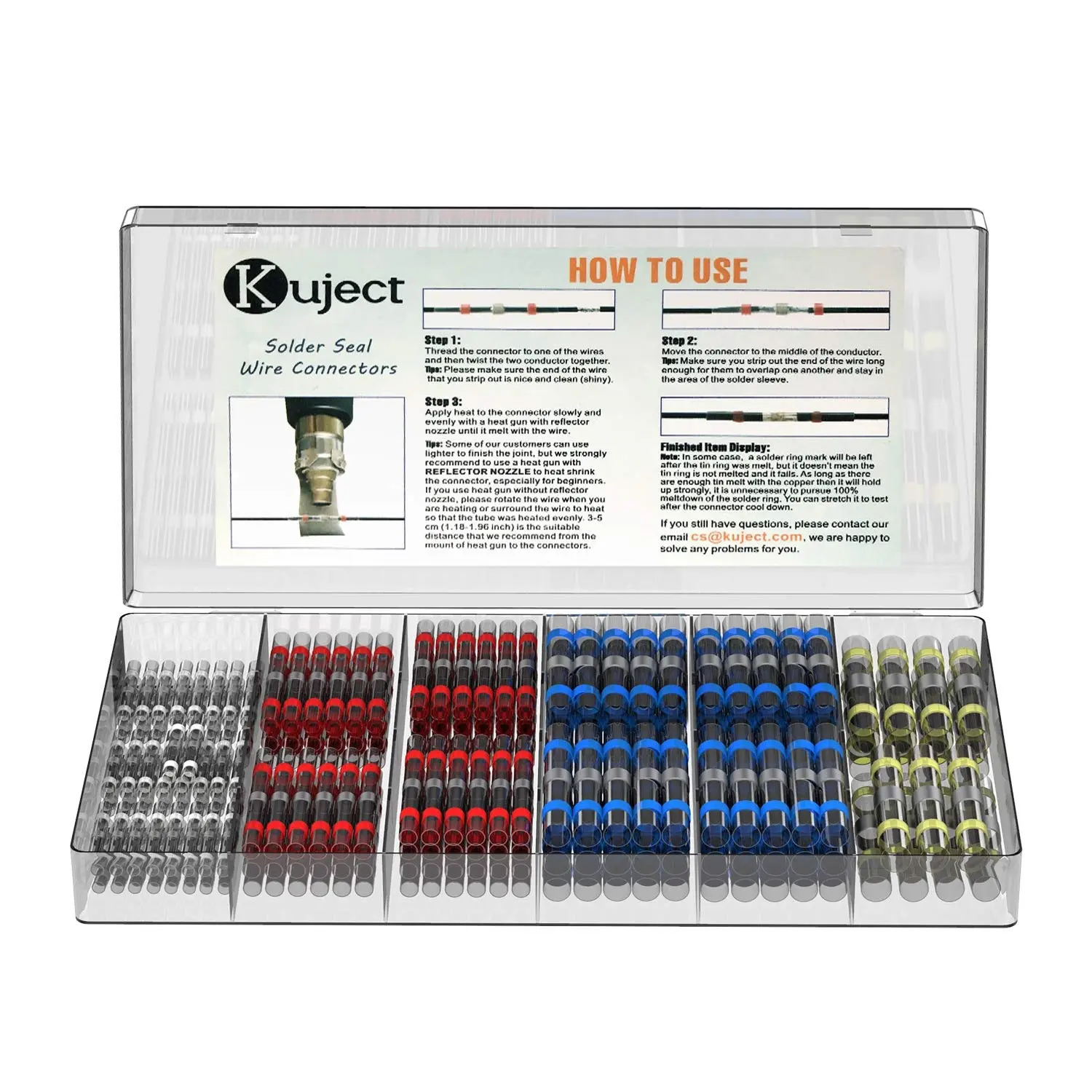
The concept is clever in its simplicity: each connector has a ring of low-temp solder in the center flanked by two bands of heat-activated adhesive. You strip two wires, slide them into either end until they meet in the middle, and apply heat. The solder melts and flows around the copper strands, then the outer bands shrink and the adhesive seals both ends. One step, no crimping tool, no separate heat shrink tubing. For an installer punching out a dozen connections in a junction box, that is a genuine time saver.
Do These Actually Hold Up Against Traditional Soldering?
This is the question that comes up in every forum thread about solder seal connectors, and the answer depends entirely on the application. For low-voltage DC wiring — security cameras, access control readers, LED lighting, thermostat wire — these connectors are more than sufficient. I tugged on every connection I made during the camera install and none budged. The solder wicks into the copper strands cleanly, and the adhesive seal creates a watertight barrier that traditional heat shrink over a solder joint does not always guarantee.
Where they fall short is on anything carrying line voltage or high current. The solder ring inside these connectors is a thin band — it melts and flows, but you do not get the deep penetration of a properly done hand-soldered joint with separate flux. If you are wiring a 20-amp circuit or anything inside a breaker panel, use traditional crimps or hand-solder with marine-grade heat shrink. These are not a replacement for UL-listed connectors in code-governed work. But for the kind of low-voltage infrastructure that runs through hotels, commercial buildings, and smart homes — 18/2, 22/4, Cat6 pigtails — they are perfectly matched to the task.
How Much of a Learning Curve Is There With the Heat Gun?
Your first three connectors will look ugly. That is just how it goes. The key variable is heat gun distance — too close and the tubing scorches before the solder flows; too far and the solder never melts. I found the sweet spot at about two inches with a 750-degree heat gun, rotating the connector slowly. The solder ring visibly collapses and the tubing shrinks tight around the wire jacket. The translucent tubing is actually a feature here — you can watch the solder flow and confirm the connection without a pull test.
A lighter works in a pinch but produces uneven heat and leaves soot on the tubing. If you are doing more than five connections, a proper heat gun with a deflector nozzle is worth the investment. The color-coded bands on the Kuject connectors correspond to wire gauge — red for 18-22 AWG, blue for 14-16, yellow for 10-12 — and the sizing is accurate. I used the red connectors for 22/4 security wire and the blue for 16/2 speaker cable. Both sized correctly.
Where Do These Make the Most Sense?
The strongest use case for solder seal connectors is anywhere moisture is a concern. Traditional butt crimps with separate heat shrink leave a tiny gap at each end where water can eventually wick in. The adhesive lining in these connectors melts and flows into a complete seal around the wire jacket — I submerged a test connection in a bucket of water for an hour and found zero ingress when I cut it open. For outdoor camera pigtails, landscape lighting, gate access wiring, or marina electrical work, that waterproofing alone justifies the per-connector cost.
They also shine in tight spaces. Crimping tools need clearance to open their handles. A heat gun nozzle can reach into a junction box at an angle that no crimper can match. I made three connections inside a single-gang masonry box that would have been impossible with a ratchet crimper. If you regularly work inside crowded back boxes or behind equipment racks, these connectors will save you a measurable amount of frustration.
The solder-and-seal action happens fast once you have the technique down — the solder ring visibly collapses into the copper, and the tubing shrinks tight around the jacket in about five seconds of heat. A proper ratchet crimping tool is still the right call for traditional butt connectors, but for outdoor and low-voltage work where waterproofing matters more than sheer mechanical strength, the one-step approach is hard to beat.
Pros, Cons, and Verdict
Pros
- One-step solder + seal + waterproof — no separate crimp, solder, and heat shrink steps
- Translucent tubing lets you visually confirm the solder flow before moving on
- Works in tight spaces where a crimping tool cannot fit
- Color-coded bands accurately match wire gauge — no guesswork
- At under six cents per connector, the per-connection cost beats buying separate solder, crimps, and heat shrink
Cons
- Not rated for line-voltage or high-current applications — keep these on low-voltage DC circuits
- Heat gun technique has a learning curve — expect to ruin your first few connectors while you dial in the distance
- A lighter works but is inconsistent — you really want a heat gun for professional results
- Solder joint is thinner than a proper hand-soldered connection — adequate, not exceptional
The bottom line: The Kuject 200-piece solder seal connector kit is not a replacement for every connector in your toolbox. It will not pass an electrical inspection on mains wiring, and a seasoned electrician will rightfully prefer a hand-soldered joint for mission-critical connections. But for the low-voltage installer running security, data, A/V, and access control wiring — the kind of person who spends their days inside hotel IDF closets and equipment rooms — these connectors eliminate three steps per connection and produce a waterproof seal that a standard butt crimp cannot match. At six cents a connector, they pay for themselves in saved time on the first project.
Kuject 200PCS Solder Seal Wire Connectors
Self-soldering waterproof butt connectors — heat, seal, and solder low-voltage wiring in one step.
View ProductHere is how the Kuject kit breaks down on specs:
| Product Specs | |
|---|---|
| Brand | Kuject |
| Piece Count | 200 connectors |
| Wire Range | AWG 10 – 22 |
| Connector Type | Solder seal (self-soldering + heat shrink + adhesive) |
| Color Coded | Red (18-22), Blue (14-16), Yellow (10-12) |
| Waterproof | Yes — adhesive-lined heat shrink seal |
| Heat Source | Heat gun recommended (750°F); lighter compatible |
For the low-voltage installer who values speed, waterproofing, and not burning their knuckles on a soldering iron inside a junction box, this kit earns its spot in the tool bag. Just keep it on the DC side of the transformer. For pulling structured cable through a new build, the techniques in our structured cabling best practices guide complement this kit perfectly — solid terminations start with clean pulls.