
FLYPROFiber OS2 Outdoor Armored Fiber Review: 50m Pre-Terminated LC Duplex Cable
When our inn expanded guest WiFi to the carriage house 160 feet from the main building, copper Ethernet wasn't an option — too much risk of ground potential difference between the two electrical panels. I needed pre-terminated single mode fiber that could handle a direct-burial trench and survive New England winters. After pricing a custom assembly at over 500 USD, I took a chance on this FLYPROFiber OS2 armored cable at 69.99 USD.
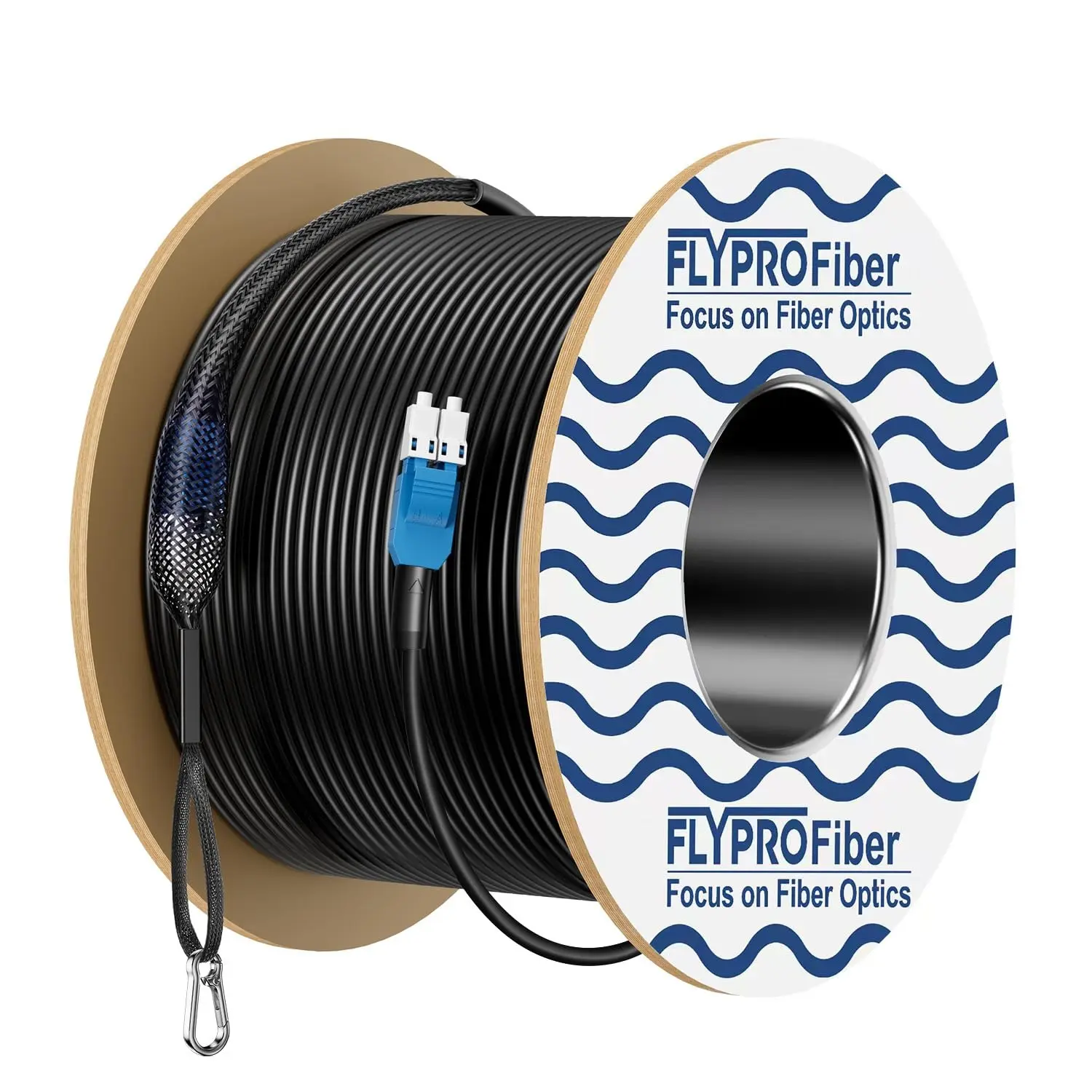
I've now had it buried for about eight months, and the connection has been rock-solid across every season. The pulling eye kit made the conduit pull straightforward, though the spool memory from the tightly-wound coil took some patience to work out. If you're connecting two buildings on a hospitality property — main lodge to pool house, innkeeper's cottage to reception — this is the cable I'd reach for again.
Does This Armored Fiber Cable Actually Need to Be Grounded?
This was the first thing I researched before trenching. The cable has a steel armor layer under the TPU jacket, and anything metallic running between buildings needs to be bonded on one end — I connected the armor to the equipment rack ground bar in the main building and left the carriage house side floating. This prevents ground loops while still giving lightning-induced current a path to earth.
If you want to skip the grounding question entirely, Kevlar-armored cable is the alternative. But for the price difference, steel armor with one-end grounding is what practicing installers recommend. The NEC guidance applies here: any conductive cable bridging two structures requires bonding at a single point.
The TPU jacket is the real standout for outdoor installations. It's UV-resistant, handles temperature swings from frozen ground to summer heat, and doesn't get brittle like cheaper PVC-jacketed cable after a year of sun exposure. I've pulled the slack box open twice now to check for moisture ingress, and both times the jacket and connectors were bone dry. For the weather swings a hospitality property sees year-round, this jacket material matters.
Can You Cut This Cable to Length?
No — the LC connectors are factory-terminated with UPC ceramic ferrules, and you can't re-terminate single mode fiber without a fusion splicer. Buy the exact length you need, because excess becomes a slack loop. I ordered 50 meters for what turned out to be a 35-meter run, so I coiled 15 meters of slack into a figure-eight inside the structured wiring panel.
The cable handles a surprisingly tight bend radius for armored fiber. A few installers I've talked to recommend ordering 20-30% extra on purpose — you can always pull more fiber, but you can't stretch what you already buried. The extra length also lets you relocate the patch panel later without re-pulling the whole run.
One installation detail to plan for: the pulling eye head is just over 1/2 inch wide. I had to ream my penetration hole from both sides after discovering this mid-pull. Use 3/4-inch or larger conduit if you're starting fresh, and don't skip the cable pulling lubricant — it genuinely matters when you're hauling 50 meters of armored cable through a buried conduit with bends.
Is Conduit Necessary, or Can You Direct-Bury This Cable?
The cable is rated for direct burial, and plenty of people have done it without issues for years. But I would always run conduit for building-to-building fiber, armored jacket or not. The day you need a second run — a backup fiber, a PoE camera line, or the next-generation link — you'll be glad you left a pull path. If you're planning a new build, our structured cabling guide for hotel construction covers pathway sizing and IDF placement decisions that make future fiber pulls painless.
I used 1-inch Schedule 40 PVC with gentle sweeps at the turns. The pre-installed swivel pulling eye made the actual pull straightforward — the eye rotates as it follows conduit bends instead of twisting the fiber core. The built-in pulling eye is the single best feature of this cable for a first-time fiber installation. It eliminates cable damage during the pull, which is the #1 thing that ruins pre-terminated fiber before it even gets plugged in.
A contractor I consulted during the planning phase told me he's seen direct-burial armored cable survive a decade without problems — and he's also watched a backhoe operator slice through one in three seconds flat. Conduit adds roughly 30-50 USD to a project this size. That's cheap insurance.
Pros, Cons, and Verdict
What I love:
- Dramatically cheaper than a custom assembly. I was quoted 500-700 USD for a custom 50m pre-terminated OS2 armored duplex cable. This FLYPROFiber cable cost 69.99 USD and performs identically in practice.
- Pulling eye kit included and pre-installed. The swivel eye prevents cable twist during conduit pulls, and it's already attached on one end straight out of the box. No extra parts to source.
- Industrial TPU jacket is genuinely durable. I dragged it through 100 feet of conduit, and the jacket showed zero abrasion. After eight months buried, no moisture ingress, no jacket cracking, no signal degradation.
- Uniboot LC connectors save panel space. Both fibers terminate in a single boot, which halves the penetration hole size and keeps the patch panel looking clean. For a hospitality property's wiring closet, that tidiness matters.
- Ready for 10G out of the box. I'm only running 1G now, but iPerf3 tests between the switches confirm the link is stable at 10G when I upgrade the optics.
What could be better:
- Spool memory is real. The cable holds its tightly-wound coil shape and wants to kink during the first straight pull. Work it slowly, don't jerk the line, and zip-tie every few feet to keep it dressed while you finish the run.
- Pulling head diameter needs 3/4-inch minimum. Slightly over 1/2 inch, which means upsizing conduit or reaming penetration holes. Frustrating to discover mid-install, not a dealbreaker if you plan ahead.
- Factory connector QC can vary. A small number of users have gotten cables where the LC end wasn't crimped properly. Bench-test every pre-terminated fiber before you bury it — that step is mandatory, not optional. FLYPROFiber's customer service replaced the bad units promptly, but pulling a new cable through already-buried conduit is a headache you can avoid with five minutes of testing beforehand.
Verdict: For connecting two buildings on a hospitality property — a bed and breakfast with a detached guest house, a motel running WiFi to the pool area, a small hotel expanding coverage across a courtyard — this FLYPROFiber cable is exactly the right product. It does what a 500 USD custom assembly does for roughly a seventh of the price. The pre-terminated LC connectors eliminate the need for a fusion splicer, and the armored TPU jacket means it'll survive whatever your local soil and weather throw at it. Buy the right length, bench-test before you pull, and size your conduit one size up from what you think you need. You'll have a reliable fiber link for years.
FLYPROFiber OS2 Outdoor Armored Fiber — 50m LC Duplex
Pre-terminated single mode armored fiber with pulling eye kit — ready for direct burial or conduit runs between buildings.
View Product — 69.99 USDFor a clean installation, pair this cable with bi-di SFP modules to run two independent connections over a single duplex strand — WAN on one fiber, LAN backhaul on the other. That setup simplified the network topology at our property more than I expected when I first planned the build-out.
| Product Specs | |
|---|---|
| Brand | FLYPROFiber |
| Fiber Type | OS2 Single Mode (9/125μm) |
| Connectors | LC/UPC Uniboot Duplex |
| Length | 50m (164ft) |
| Jacket | Industrial TPU (OD-5mm) |
| Armor | Steel + Stainless Steel Woven Mesh |
| Bandwidth | 1G/10G (100G capable) |
| Pulling Eye | Pre-installed swivel pulling eye on one end |
| Rating | Direct Burial, UV-Resistant, LSZH |
Bottom line: I'd buy this again without hesitation. The combination of the pre-installed pulling eye, the genuinely tough TPU jacket, and the price — under a quarter of what a custom cable shop would charge — makes this the obvious choice for building-to-building single mode fiber. On the indoor side, I pair this run with FLYPROFiber OM3 patch cables in the wiring closet — same brand, same reliability, half the cost of name-brand equivalents. Test it before you bury it, ground one end, and you'll have a link that outlasts your next three equipment upgrades.