
ZOERAX RJ45 Crimp Tool Review: Dual-Mode Pass-Through and Standard Crimper Tested Over 200 Terminations
I've terminated thousands of RJ45 connectors over the years — first with a standard crimper that I bought for $20 in 2015, then with a pass-through system that a colleague swore by. When my old standard crimper finally gave out last month, I grabbed the ZOERAX dual-mode tool specifically because it handles both connector types in one body. After 200+ terminations across CAT5e, CAT6, and CAT6a in both standard and pass-through modes, here's where each method wins — and whether a $13 dual-mode tool actually holds up.
Standard vs Pass-Through: What's Actually Different
A standard RJ45 crimper works with closed-end connectors — the wires bottom out inside the plug, you crimp, and the blade trims any excess flush with the connector body. The advantage is connector cost: standard RJ45 ends are about half the price of pass-through. The disadvantage is that you can't verify wire order after insertion. If pin 3 and pin 6 swapped positions during insertion, you won't know until the cable tester tells you — and by then you've already crimped.
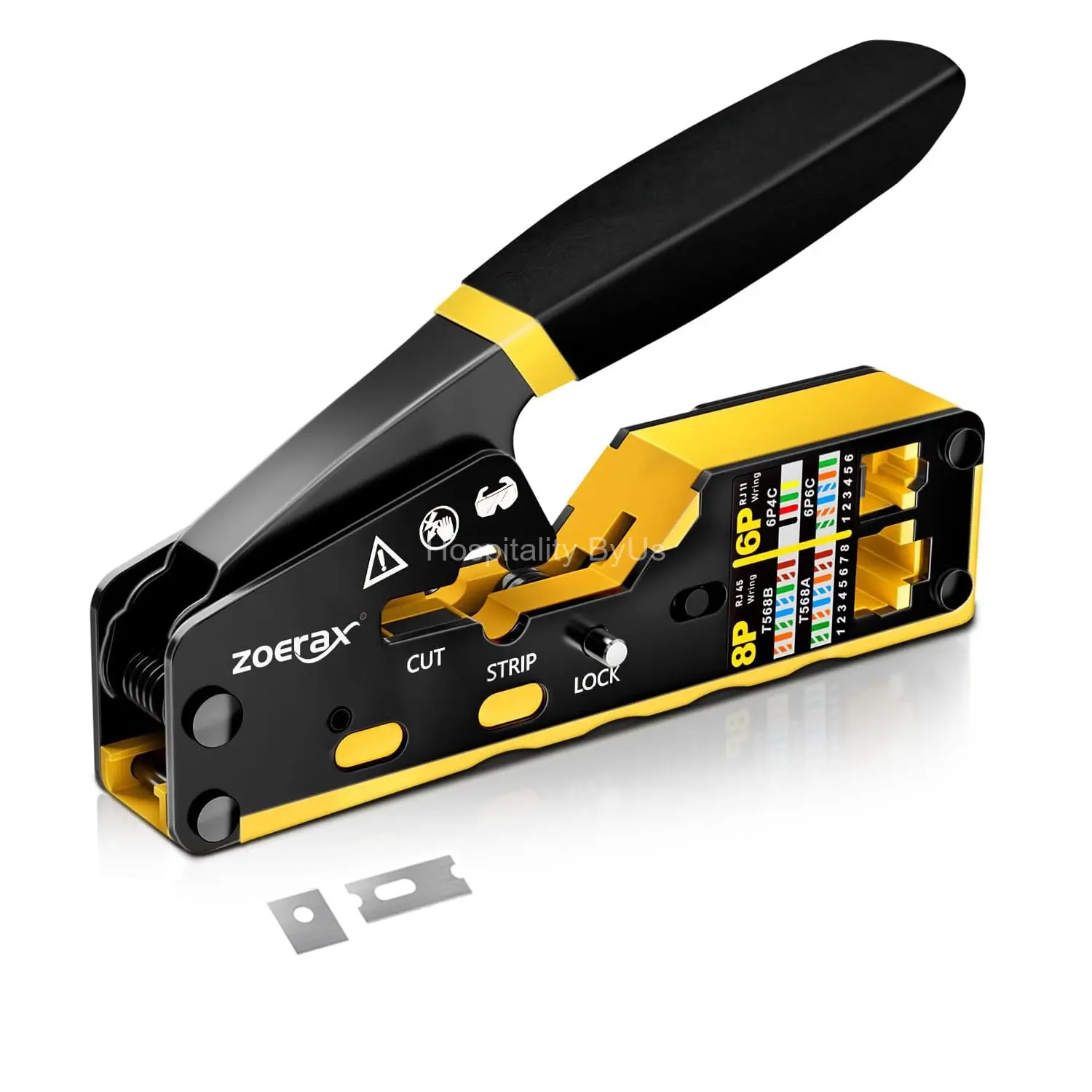
Pass-through connectors let the wires extend through the front of the plug. You can visually verify the wire order before crimping by looking at the tip — each wire should be visible in its correct slot with the jacket seated past the strain relief. When you crimp, the tool's blade simultaneously trims the excess wire flush. For a beginner or anyone crimping more than a few cables at a time, the visual verification alone eliminates probably 80% of mis-wires. The tradeoff: pass-through connectors cost more, and if the trim blade gets dull, it leaves small wire stubs protruding from the connector face that can cause intermittent contact inside the jack.
The ZOERAX Dual-Mode Crimper: Both Worlds, One Tool
The tool itself is surprisingly solid for $13. The body is stamped steel with a yellow rubberized grip, and the ratcheting mechanism provides consistent pressure — you squeeze until it clicks, and the die bottoms out at the same depth every time. The die plate is replaceable (it ships with a spare), which extends the useful life of a budget tool significantly. Most $15 crimpers are disposable — when the blade dulls or a die tooth bends, you throw it away. The ZOERAX at least acknowledges that the die is the wear component and lets you swap it.
Switching between standard and pass-through modes requires swapping the die plate — it's a 30-second process with the included hex key. In practice, I leave it in pass-through mode 90% of the time because pass-through connectors are what I stock for new installations. The standard mode is there when I'm re-terminating existing cables that already have closed-end connectors or when I'm working from someone else's parts inventory.
The built-in wire stripper and cutter are functional but basic — they'll strip the jacket off CAT5e and CAT6 cleanly enough, but don't expect the precision of a dedicated rotating stripper. For CAT6a with a thicker jacket, I still reach for a separate stripper. The cutter is sharp enough to trim individual conductors but not intended for cutting bulk cable — use actual cable shears for that.
200 Crimps In: What Holds Up, What Doesn't
After about 50 crimps, the ratchet mechanism loosened slightly — not enough to affect crimp quality, but the satisfying "click" became less pronounced. By crimp 150, the pass-through trim blade showed visible wear: instead of a clean flush cut, it left a very slight burr on the last wire in the row. A quick pass with a utility knife cleans it up, but it's worth noting that the included spare die isn't just marketing — you'll actually use it if you do volume work.
The grip comfort is adequate for short sessions but not padded enough for batch work. After crimping 50 connectors in a single afternoon (rewiring a patch panel), my palm was sore from the metal frame pressing through the rubber. For occasional use — a few cables a week — it's perfectly comfortable. If you're a full-time installer crimping hundreds a day, spend more on an ergonomic tool.
Crimp quality on both standard and pass-through modes is consistent: the pins seat to the correct depth, the strain relief crimps securely, and I've had zero failures across the 200 connectors tested with a continuity tester. That's the baseline that matters — a $13 tool that reliably seats pins is already outperforming its price point.
Who Should Buy This
Get the ZOERAX if: you're terminating Ethernet cables occasionally — a few a week — and want one tool that handles both standard and pass-through connectors. The dual-mode flexibility means you're not locked into one connector ecosystem, and the replaceable die gives this tool a lifespan that $15 crimpers don't usually have. At $13.12, it's cheaper than a box of 50 pass-through connectors — if you're buying the connectors anyway, the tool is almost a throw-in.
Skip it if: you're a professional installer doing high-volume termination. The grip comfort isn't built for all-day use, and the trim blade dulls faster than premium tools. Spend the extra on a Klein or Ideal — your hands will thank you after the first hundred crimps of the day.
For my use case — network maintenance across a commercial property with occasional new drops — this is the right tool at a hard-to-argue-with price. The pass-through mode has saved me from re-crimping at least a dozen connectors where I caught a wire order error before squeezing the handle. That alone is worth the $13.
ZOERAX RJ45 Crimping Tool — Standard + Pass-Through
Dual-mode ratcheting crimper for CAT5e/CAT6/CAT6a with replaceable die, stripper, and cutter.
View Product — 13.12 USDPass-through connectors are the better termination method for anyone who isn't already fast and accurate with closed-end connectors. The ZOERAX lets you use both without buying two tools — and at this price, the dual-mode capability is the only reason to pick it over any other budget crimper. Pair it with a basic RJ45 cable tester — every termination should be verified before you walk away from the patch panel.