
VANDESAIL 30M SC/APC Fiber Optic Cable Installation Guide
For a while, I had to deal with a standard patch cable getting chewed by a mouse every so often. I'm happy to say that armored fiber does not get chewed up by rodents.
Reason for Getting Armored Fiber
If you use standard fiber in an attic or other similar location, you're inviting mice, rats, and all other drywall-dwelling rodents and even pets. It is believed that some soy-based cable jackets may even attract pests and that is the reason for the frequent replacements. The flexible steel layer that VANDESAIL built into their cable is much stronger than what is built into standard patch cables and can help prevent rodents from chewing up your cable. I prefer using armored cables for unconditioned spaces.
A 100-foot run is typically the best to go from an ONT in the garage to the central home office.

What You'll Need for This Installation
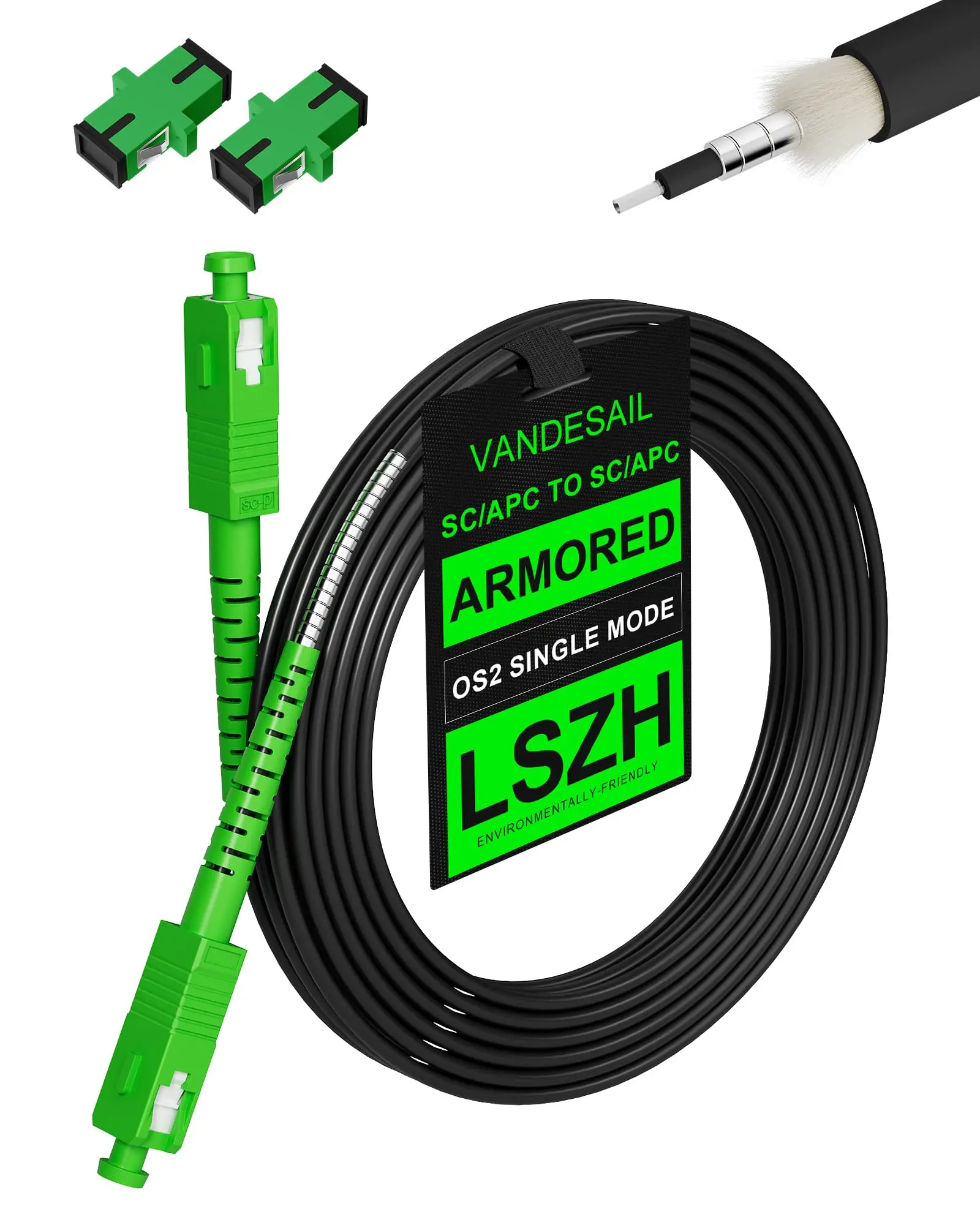
- The VANDESAIL 30M Armored SC/APC Patch Cable (includes couplers)
- Pull string (always pull a spare line for future upgrades)
- Electrical tape or a pulling mesh grip (to protect the pre-made connector during the pull)
- One-click fiber cleaner pen or 99% isopropyl alcohol with lint-free wipes
- Visual fault locator (VFL) or a simple laser pointer to check continuity
The included bulkheads/couplers are great if you need to connect this to an existing wall plate.
Step-by-Step: Running Your SC Fiber Cable
Let me describe the steps I take to complete a clean installation.
Step 1: This is a pre-terminated 100-foot cable so it can’t be cut to size. Please consider how you will secure loose slack.
Step 2: Loom the slack. If pulling through conduit, reduce the overall diameter of the SC connector by tapering the electrical tape on the SC Connector. For a pull run, secure a pull string tightly to the SC connector housing. Do not secure a pull string to the fragile green SC connector tip.
Step 3: Maintain the cable radius. Though the armored cable protects the cable from crushing, the minimum cable bend radius still has to be maintained. Kinks have to be avoided and loops have to be kept wide, about the diameter of a paint can.
Step 4: Figure 8 the slack. Once the desired length of cable has been extended, the slack cable has to be securely housed. Figure eights over slack cable can be placed in a media enclosure. Do not cut the factory terminated cables and do not remove the terminator connectors to terminate your lines. The connectors have to be dust proof and protect the connectors over a length of run.
Step 5: Clean the connectors. The SC/APC connectors should be cleaned before use to avoid damage. The hooks should be stowed while the connectors are not in use to avoid damage. The outer coverings can be removed before the connectors are installed to avoid damage. The connectors should be installed firmly to avoid damaging the run. The run is protected in a steel sheath. The cost of the run is protected.
Pro Tips I've Picked Up Along the Way
If your equipment uses smaller SFP modules, check your ports—you might need a LC-to-LC patch cord instead of this bulkier SC type. For standard home layouts, 100 feet avoids the headache and hassle of field-terminating bulk fiber.
The price difference between armored and non-armored has shrunk considerably. I've seen armored cables priced only 50-100% more than standard patch cables at the specialty suppliers — and at $24.64 for 100 feet, this VANDESAIL cable makes armored the easy choice. I've never regretted paying the premium for steel armoring, but I have definitely regretted the opposite.
Know your connector types before you buy. The SC/APC connector is what most US fiber providers use — AT&T, Cox, Frontier, and Google Fiber all terminate with SC/APC at the customer premises. But if your equipment uses smaller SFP transceivers and media converters with LC ports, you'd need a LC to LC fiber patch cable single mode duplex instead. The green connector on SC/APC is your visual cue that you got the right type — a blue connector is UPC and uses a different polish angle, so it won't mate correctly with APC equipment.
Simplex vs duplex is another consideration. This VANDESAIL cable is SC simplex — a single fiber strand. That's exactly what you need for most residential GPON/FTTH installations where the ISP only sends one fiber to the ONT.
Final Thoughts
Single strand usage is possible when duplex SFP transceivers are replaced by simplex SFP transceivers. For runs approaching 1,000 feet, I've considered bulk fiber optic cable options — but for residential installs, the need for bulk fiber is rare since most home runs stay well under 100 feet.
The VANDESAIL SC/APC armored cable has been my go-to for every client extending fiber to their home. It matches what US internet service providers terminate with at the ONT, so there's no adapter dance. I've tested this exact 100-foot run on my own 5-gig setup and haven't measured any added latency — the signal comes through as clean as a 3-foot patch cable.
A 100-foot fiber run is well within reach for a careful DIYer. Plan the route ahead of time, pull a spare string alongside the cable, keep the connector ends capped and clean during the pull, and you'll have it installed inside an hour. Just don't skip the armor — the rodents in your attic are already scouting the buffet.