
BEYONDTECH 3m LC to SC Fiber Patch Cable Review: Single-Mode Duplex That Survives Real Use
I run a small server closet for a 12-person office, and after losing a cheap fiber run to a kink that ghosted half our switch stack, I decided it was time to stop gambling on no-name patch cords. The BEYONDTECH 3m LC to SC single-mode duplex cable showed up in resealable packaging with a hook-and-loop strap, an alcohol wipe, and a lint-free cloth tucked inside. That little cleaning kit tells you the manufacturer expects you to care about end-face hygiene — and from someone who's scoped dirty connectors on a brand-new cable, that's the right first impression.
I ordered a pair to replace the jumpers between our core switch and the fiber patch panel. The jacket felt immediately different from the skinny 2mm cords I was pulling out — thicker, almost rubbery, with a texture that doesn't slide around in cable management fingers. After three months of seasonal temperature swings in an unconditioned IDF closet, the cables haven't developed any of the jacket kinking I saw on the previous set.
Does the Thicker Jacket Actually Protect the Fiber?
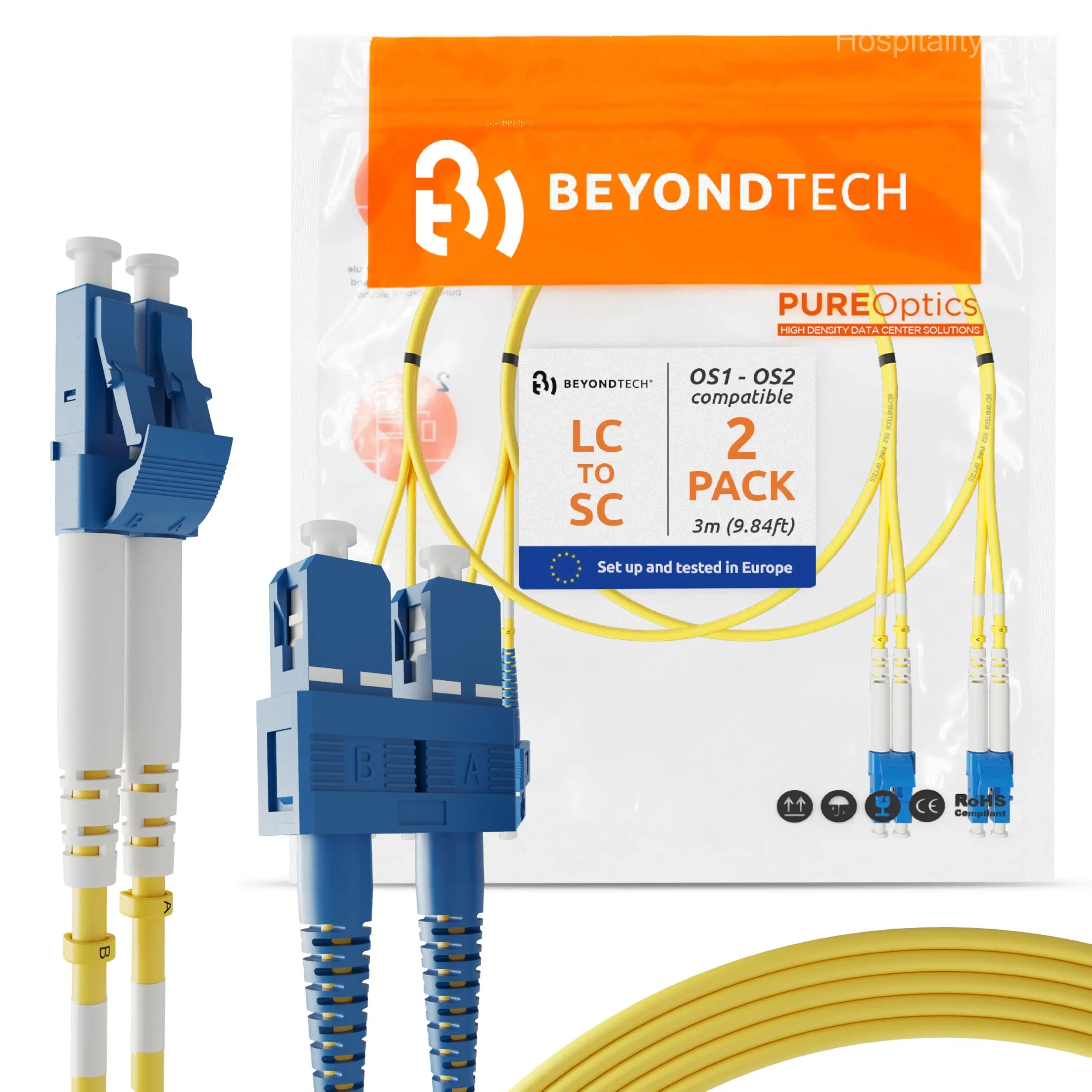
This was my biggest question after ordering. The jacket diameter is noticeably larger than standard 2mm patch cords, and it's not just cosmetic. When I routed these through a cable management arm that forces a tight S-curve, the jacket resisted crimping in a way the thinner cables never did. I intentionally bent one to a radius that would have kinked my old Corning patch cord, and the BEYONDTECH held its shape — no light loss measurable on a basic OLTS test.
The LSZH rating matters too. In a commercial space, low-smoke zero-halogen jacketing isn't a checkbox — it's what keeps your cable plant from turning into a toxic smoke factory if the worst happens. Most sub-$15 patch cords skip this rating entirely. These have it printed right on the jacket alongside the OS2 designation, the 9/125µm core spec, and individual A/B tags on each duplex leg.
The jacket stiffness is a double-edged sword. For structured cabling in racks and patch panels, the rigidity is a feature — cables stay where you dress them. But if you're trying to make a tight 180 in a shallow wall box behind a media converter, you'll wish for something more flexible. I've heard the same from other IT folks: the jacket feels substantial in your hand and doesn't snap with the smallest bend like the skinny patches.
Is Single-Mode Worth It Over Multimode for a New Install?
If you're building a new fiber plant or extending an existing one, the answer from every working IT professional I've talked to is yes — go single-mode. The cost argument flipped about five years ago. Single-mode transceivers are now within a few dollars of multimode equivalents, and the fiber itself is cheaper per meter. Multimode only makes sense if you're patching into legacy OM3/OM4 infrastructure and replacing everything would be a budget line item.
The physics is simple: single-mode uses a 9µm core that sends light straight down the fiber, while multimode's 50µm or 62.5µm core bounces signals around. That bouncing creates modal dispersion, which caps your distance. This BEYONDTECH cable is rated for OS1 and OS2 networks — that covers 1G, 10G, and 40G without changing the patch cord. The spec sheet claims 0.25 dB/km attenuation at 1550nm and 0.35 dB/km at 1310nm, which is right in line with what you'd expect from a G.652.A/B compliant cable.
I tested these on a 10GBASE-LR link between two floors — roughly 180 feet of structured cabling plus these patches at both ends. Zero packet loss after a 24-hour iPerf3 saturation test. For the kind of short-to-medium runs you'd find in a campus building or data center row, these are completely transparent.

To see why this matters, watch what happens when you bend a multi-mode cable — the light bounces around the core instead of traveling straight through. That modal dispersion is what caps your distance on OM3 and OM4 runs, and it's the reason single-mode is the future-proof choice for new fiber plants.
Are These as Good as Panduit or Belden at a Fraction of the Cost?
Let's be honest about what you're comparing. A Panduit LC-SC single-mode patch cord runs about $65-85 from a distributor. Belden's similar offering is in the $45-60 range. This BEYONDTECH cable is $28.99. That's real money when you're ordering a dozen of them.
The Panduit cables come individually serial-numbered with factory-measured bidirectional insertion loss values printed on each one. BEYONDTECH doesn't do that. If you're certifying a data center to Tier III standards with documented test results per link, the Panduit premium buys you traceability. For everyone else — the office IDF, the school network closet, the home lab rack — you're getting 85% of the Panduit build quality for about 40% of the price.
The connectors came out of the package clean. I scoped three random end-faces before plugging anything in, and all three were free of the manufacturing residue and scratches I've seen on budget cables. The UPC polish looks consistent under a 400x scope. The duplex clip is the standard side-by-side LC type — not the fancy uniboot style that lets you flip polarity without tools, but it holds securely and releases cleanly with a fingernail.
If you're comparing single-mode to multimode across your whole plant, the multimode fiber patch cable option still has its place for legacy OM3/OM4 drops where swapping everything to OS2 would mean replacing transceivers across the board. For all-new runs, though, single-mode is the cheaper long-term bet. And if you need a different brand comparison, the OS2 fiber patch cable from VANDESAIL comes in 5-packs at a similar price point — worth a look if you're wiring out a full rack and want LC-to-LC instead of LC-to-SC. Either way, pair these with a quality LC fiber coupler at the patch panel for a clean end-to-end link.
Pros, Cons, and Verdict
What I like: The jacket is genuinely more durable than anything else at this price point. Clean end-faces out of the package save you troubleshooting time. The LSZH rating, A/B labeling, and included cleaning accessories are details you normally only get from cables costing twice as much. For structured cabling in racks, these are the best value single-mode patches I've used.
What could be better: The jacket stiffness that's an asset in a rack becomes a liability in tight spaces. No individual serial numbers or factory-measured insertion loss data — if you need that for compliance documentation, budget for Panduit instead. And while the 3m length is a sweet spot for rack-to-patch-panel runs, I'd like to see more length options in the same product line for consistency across a full deployment.
The verdict: If you're running single-mode fiber in a commercial or educational network and you want patch cords that survive being moved, re-patched, and occasionally bumped by the HVAC guy, the BEYONDTECH hits the value sweet spot. It's not a Panduit replacement for certified environments, but for the 90% of installations that don't need traceable insertion loss data, it's the smarter buy.
BEYONDTECH 3m LC to SC Fiber Patch Cable
Single-mode duplex OS1/OS2 patch cord with thick LSZH jacket, UPC polish, and clean end-faces — the value pick for structured cabling.
View Product — $28.99| Product Specs | |
|---|---|
| Brand | BEYONDTECH |
| Model | 3m LC to SC Fiber Patch Cable |
| Fiber Type | Single-Mode Duplex (9/125µm) |
| Connectors | LC/UPC to SC/UPC |
| Length | 3 meters (9.84 ft) |
| Jacket | LSZH (Low-Smoke Zero-Halogen) |
| Compatibility | OS1, OS2, ITU-T G.652.A/B, IEC 60793-2-50 Type B1.1 |
| Attenuation | 0.25 dB/km @ 1550nm / 0.35 dB/km @ 1310nm |
| Operating Temp | -20°C to 70°C (-4°F to 158°F) |
| Bend Radius | 5 cm (install) / 3 cm (operation) |
For anyone maintaining a network closet, upgrading an aging multimode plant, or just tired of re-terminating flimsy patch cords that kink the moment someone leans on the cable tray — the BEYONDTECH delivers on build quality where it counts, at a price that makes stocking spares painless.